Lab Manual for ManyBabies 5: Hunter & Ames Model of Infant Looking Preference
This lab manual is still UNDER DEVELOPMENT!
Bear with us as we finalize this document with all of the information your lab will need to successfully collect data for MB5. In the meantime, feel free to poke around and email us at mb5@manybabies.org if you have any questions or need help.

Preface
Thank you for contributing to ManyBabies 5, a project of ManyBabies!
Manual Overview
This manual provides the information needed to participate in ManyBabies 5. The manual is divided into five sections (General information, Getting Started, Setting up the experiment, Running the experiment & After data collection). Each section is divided into chapters, which you can jump to using the navigation panel on the left of the screen.
If you find any errors (big or small!) or would like to suggest edits/improvements, we want to hear about it! You can let us know by creating an issue via the MB5 manual github (click on Issues then New issue).
ManyBabies 5 Overview
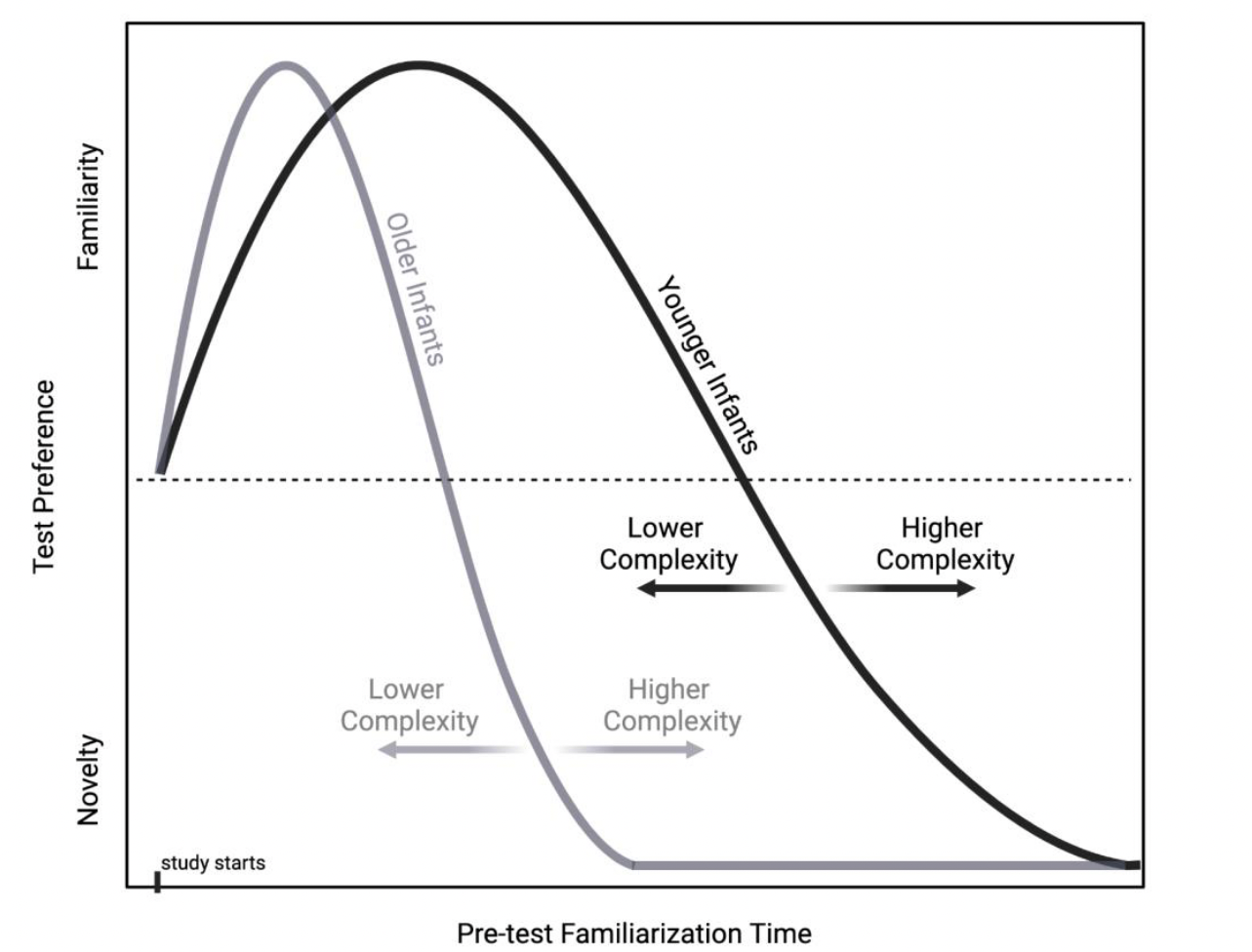
MB5 is a cross-lab effort to provide an empirical basis for discussions of replicability as well as cultural, developmental, and methodological variability in infant perception/cognition research. In this project, we are examining drivers of infants’ familiarity vs. novelty preference through a collaboratively-designed “best test” of a popular model of infants’ visual preference for familiar and novel stimuli (Hunter & Ames, 1988). More details about the background, design and hypotheses can be found in the MB5 Stage 1 Registered Report (Kosie et al., n.d.). In the following sections, we provide instructions for getting ready to run the experiment, implementing the experiment in your lab, and reporting data back to the project as a whole. Thanks for joining us!
Acknowledgments
Much of this manual was adapted from the lab manuals created by the MB1, MB2, MB3, and MB4 teams.
This is a  book.
book.
To learn more about Quarto books visit https://quarto.org/docs/books.
License

This work is licensed under a Creative Commons Attribution-NonCommercial 4.0 International License.