
 Status:
 MB2.1: under review (Stage 2); MB2.2 and MB2.3: design


 Contact:
 manybabies2@gmail.com
Listserv: Subscribe
 521 babies tested by 45 labs
 55 authors from 10 countries on PsyArXiv preprint
In this project, we investigate a fundamental feature of human social cognition: Theory of Mind (ToM), the ability to ascribe mental states to agents. One of the central tests for ToM is the false belief task, which requires participants to predict an agent’s action based on her/his (mis)representation of the world. Using a false belief task implemented through 3D-animated videos, we examine whether toddlers (18- to 27-month-olds) and adults show anticipatory looking indicating false belief ascription to another agent. Our team includes the authors of the original studies as well as researchers who conducted previous replication attempts. Our consortium brings together scholars from a wide range of theoretical perspectives.
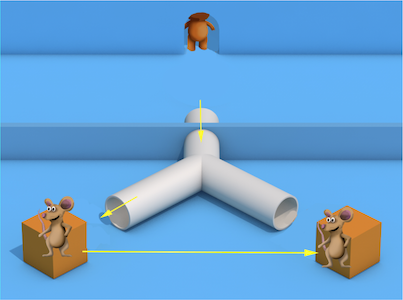
MB2.1: Knowledge / Ignorance in Infancy (completed):
In a first step, we examined whether toddlers’ and adults’ anticipatory looks show that they distinguish between two basic forms of epistemic states: knowledge and ignorance. Adults (n = 703) clearly differentiated between those conditions and showed more anticipatory looking towards the target location in the knowledge than in the ignorance condition. Surprisingly, in toddlers (n = 521) this pattern was flipped: They showed more anticipatory looks towards the target location in the ignorance condition (see Figure 1).
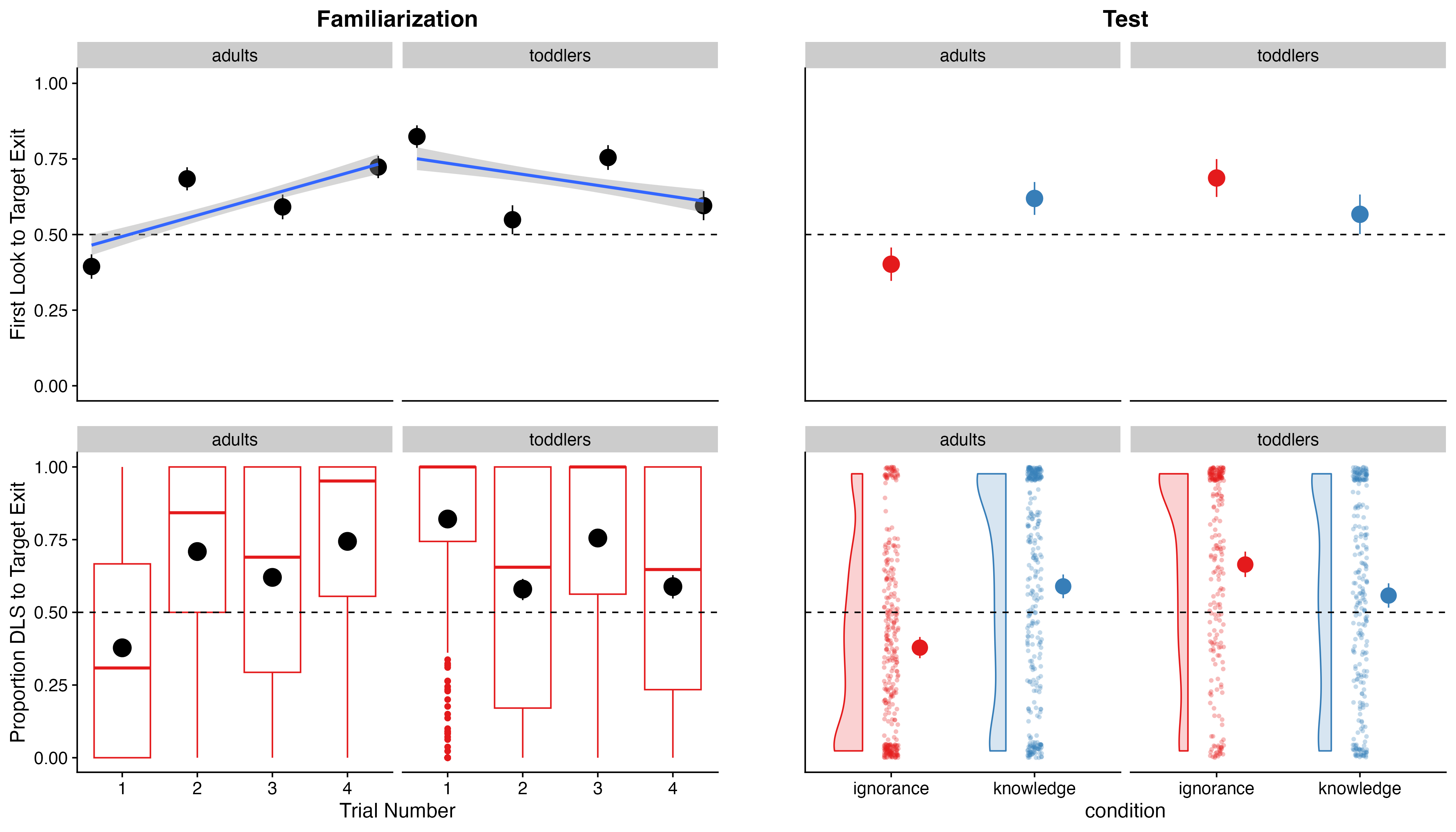
Figure 1. First look and proportion differential looking score (DLS) for toddlers and adults during familiarization and test phase.
MB2.2: Knowledge / Ignorance Adaptation in Infancy (ongoing):
The next step for toddlers will now be to investigate more systematically the source of the puzzling findings from MB2.1 and clarify whether they indicate competence or mere performance limitations.
MB2.3: False Belief in Adults (ongoing):
For adults, we will now move on to probe whether their spontaneous action anticipation is also sensitive to more complex kinds of epistemic states, such as true and false beliefs.
Following the anticipatory looking studies, we hope to continue the project with other measures such as Violation of Expectation, and interactive tasks.
Links
- Materials, Protocols, and Documentation: MB2-OSF,
- Data and code: MB2-GitHub
- Slack: MB workspace (join the #mb2-general channel)
Funding
- MB2 is supported by a grant from Deutsche Forschungsgemeinschaft
Project Leads
-
Tobias Schuwerk, Ludwig-Maximilians-Universität München
 [email]
-
Dora Kampis, University of Copenhagen [email]
-
Hannes Rakoczy, Georg-August-Universität Göttingen [email]
-
Michael C. Frank, Stanford University [email]
MB2 Contributors
NOTE: Default table ordering is by contributor's first name or by publication author order. You can filter, group, and/or sort entries by any field.
Project contributors can update/add info to the MB Dashboard using this form
Publications
View full author list
Dora Kampis
Renée Baillargeon
Szilvia Biro
Manuel Bohn
Krista Byers-Heinlein
Sebastian Dörrenberg
Cynthia Fisher
Laura Franchin
Tess Fulcher
Isa Blomberg
Alessandra Geraci
Charlotte Grosse Wiesmann
J. Kiley Hamlin
Daniel Haun
Robert Hepach
Sabine Hunnius
Daniel C. Hyde
Petra Kármán
Heather L. Kosakowski
Ágnes Melinda Kovács
Anna Krämer
Louisa Kulke
Crystal Y. Lee
Casey Lew-Williams
Ulf Liszkowski
Kyle Mahowald
Olivier Mascaro
Marlene Meyer
David Moreau
Josef Perner
Diane Poulin-Dubois
Lindsey J. Powell
Julia C. Prein
Beate Priewasser
Marina Proft
Gal Raz
Peter J. Reschke
Josephine Ross
Katrin Rothmaler
Rebecca Saxe
Dana Schneider
Victoria Southgate
Luca Surian
Anna-Lena Tebbe
Birgit Träuble
Angeline Sin Mei Tsui
Annie E. Wertz
Amanda L. Woodward
Francis L. Yuen
Amanda Rose Yuile
Luise Zellner
Lucie Zimmer
Michael C. Frank
Hannes Rakoczy
Spin-off Projects
 MB-ManyTrackers: Evaluating Eye-Tracking Consistency and Accuracy and Its Impact on Key Dependent Variables across Different Systems in the ManyBabies2 Project
 - MB-ManyWebcams: Web-based Eye Tracking for Infant Studies
- MB2.2: Knowledge/Ignorance in Infancy (adaptation)
- MB2.3: False Belief in Adults
- MB2P: Pupil Dilation to Measure Violation-of-Expectation